Retail tenant mix must reflect local demand: the retail category leading demand in Metro Manila is not the same category driving requirements in provincial markets.
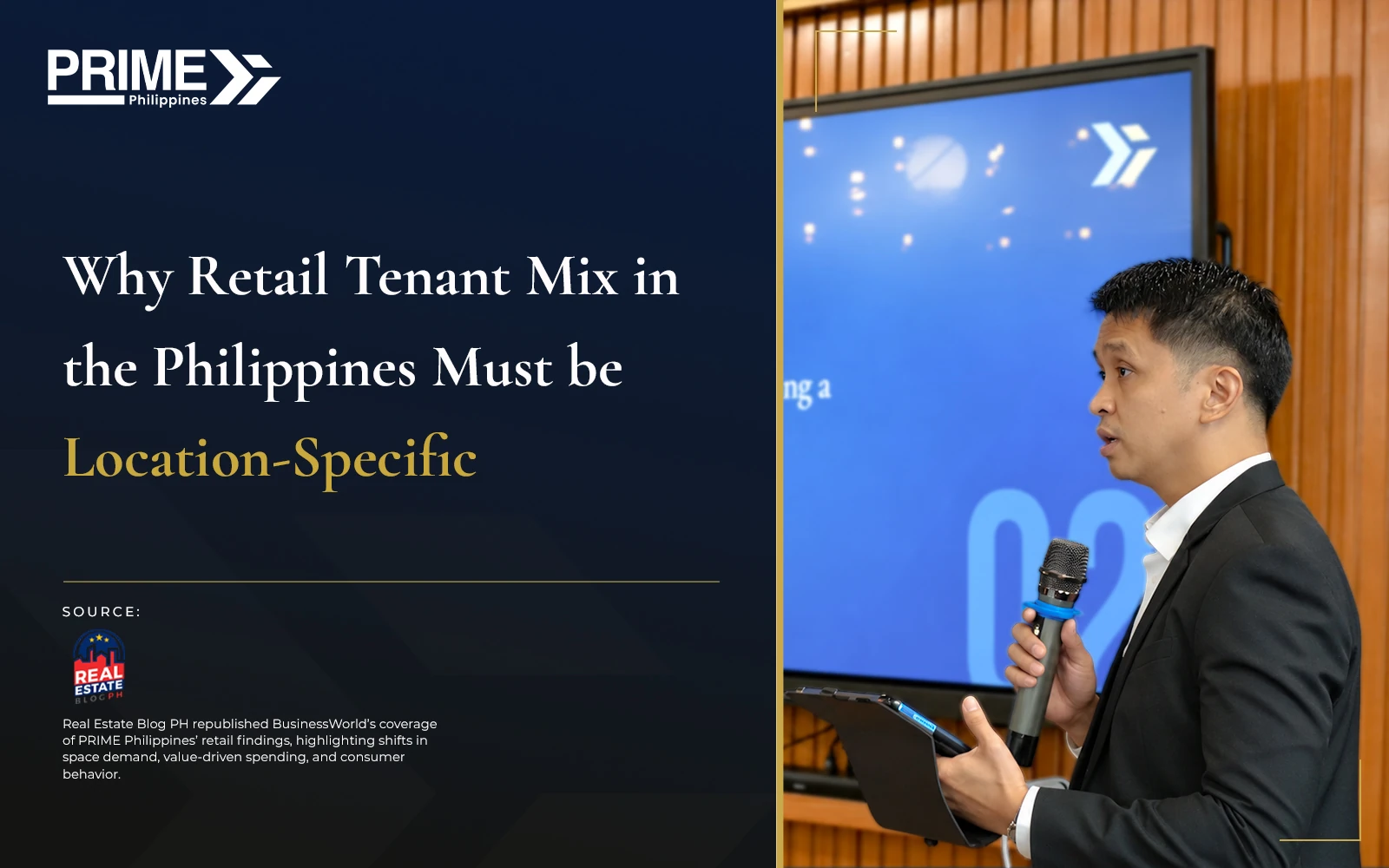
Real Estate Blog PH republished BusinessWorld’s coverage of PRIME Philippines’ mid-year retail findings, extending the visibility of its research on new retail space requirements, value-oriented spending, and changing consumer behavior.
The findings reveal a market that cannot be understood through a single nationwide tenant formula. Grocery and convenience operators led demand in Metro Manila, while health, wellness, and beauty concepts accounted for the largest share of requirements in provincial hubs.
For landlords and developers, the contrast reinforces the importance of aligning retail tenant mix with the needs of each property’s trade area.
Groceries Lead Metro Manila Retail Requirements
According to the PRIME Philippines findings featured by Real Estate Blog PH, grocery and convenience stores accounted for 37% of new retail space requirements in Metro Manila, equivalent to approximately 35,500 square meters.
General merchandise followed with a 28% share. Health, wellness, and beauty concepts represented 21%, while food and beverage tenants accounted for the remaining 14%.
The strength of grocery and convenience formats reflects consumers’ continued focus on value, accessibility, and essential purchases. These operators also benefit from recurring demand because they address needs that arise daily or weekly.
PRIME Philippines Senior Head for Retail Tenant Representation Sondi Tuazon noted that consumers have become more informed, connected, and intentional. Price comparison, customer reviews, and perceived value are increasingly influencing where and how people spend.
This gives value-oriented retailers a stronger position within the retail tenant mix. Grocery, convenience, and general merchandise operators are no longer simply supporting tenants. In many developments, they are becoming major traffic generators.
Provincial Retail Demand Tells a Different Story
Outside Metro Manila, PRIME Philippines recorded approximately 47,900 square meters of tenant requirements across provincial hubs.
Health, wellness, and beauty concepts led provincial demand with a 37% share. Showrooms accounted for 17%, while grocery and convenience stores represented 16%. Food and beverage concepts contributed 10%, with the remaining requirements distributed among other tenant categories.
The difference between Metro Manila and provincial demand shows why national trends must be interpreted carefully.
A category performing strongly in one market may play a different role elsewhere because of variations in household income, population density, competition, accessibility, consumer routines, and available retail supply.
For developers, the objective should not be to replicate the same tenant composition across every property. It should be to understand which uses respond most directly to the needs of the surrounding community.
How Value Retail Shapes Retail Tenant Mix
Real Estate Blog PH also featured PRIME Philippines’ assessment of value retail as one of the leading forces shaping the sector.
Discount retailers and value-oriented grocery formats continue to expand as consumers look beyond low prices and place greater importance on the overall value of each purchase. This includes product usefulness, accessibility, convenience, and price relative to quality.
The expansion of these formats affects how retail properties are planned and positioned. Operators that attract frequent, purpose-driven visits can provide a stable traffic base for the wider development.
However, their contribution depends on how they are integrated into the property. Access, visibility, parking, circulation, unit configuration, and adjacency to complementary tenants all influence whether an anchor’s traffic benefits the rest of the retail environment.
Food and Beverage Expansion Is Becoming More Selective
Food and beverage remains an important component of retail strategy because dining can generate repeat visits and extend the amount of time consumers spend within a property.
However, PRIME Philippines’ findings also point to the effect of higher construction and development costs on expansion decisions. Opening a new location now requires more capital, making site selection and commercial terms increasingly important.
For food and beverage operators, growth is no longer simply about adding stores. Each location must justify its investment through the right market, rental structure, format, and consumer base.
This creates a more selective leasing environment. Landlords must assess not only whether an operator is interested in a space, but whether the property can support the tenant’s long-term performance.
Retail Tenant Mix Must Respond to Local Demand
A strong retail tenant mix in the Philippines should reflect how a particular community lives, shops, and spends.
Metro Manila’s grocery-led demand points to the importance of convenience and value within a dense urban market. The stronger provincial share of health, wellness, and beauty concepts suggests a different pattern of consumer demand and expansion.
Neither market should be treated as the universal model.
Trade-area demographics, purchasing power, nearby competition, transport access, consumer behavior, and the existing tenant base must all inform leasing decisions. The percentages provide a market benchmark, but property-level strategy requires a more detailed understanding of location.
Strategic Outlook: National Trends Require Local Interpretation
Real Estate Blog PH’s republication of BusinessWorld’s coverage extends the reach of PRIME Philippines’ central retail finding: demand remains active, but its composition varies substantially by market.
The strongest retail strategies will not simply follow whichever category holds the largest national share. They will identify which tenants generate relevant and sustainable demand for the specific property.
For landlords and developers, that means treating retail tenant mix as a strategic response to the trade area rather than a standardized leasing template.
PRIME Philippines provides retail market research, trade-area assessment, tenant representation, and strategic leasing advisory services across Metro Manila and key provincial markets.
Build a retail tenant mix grounded in local demand. Talk to our advisor now.