Uncertainty is affecting how businesses assess risk, but it has not removed the underlying opportunities shaping the Philippine property market.
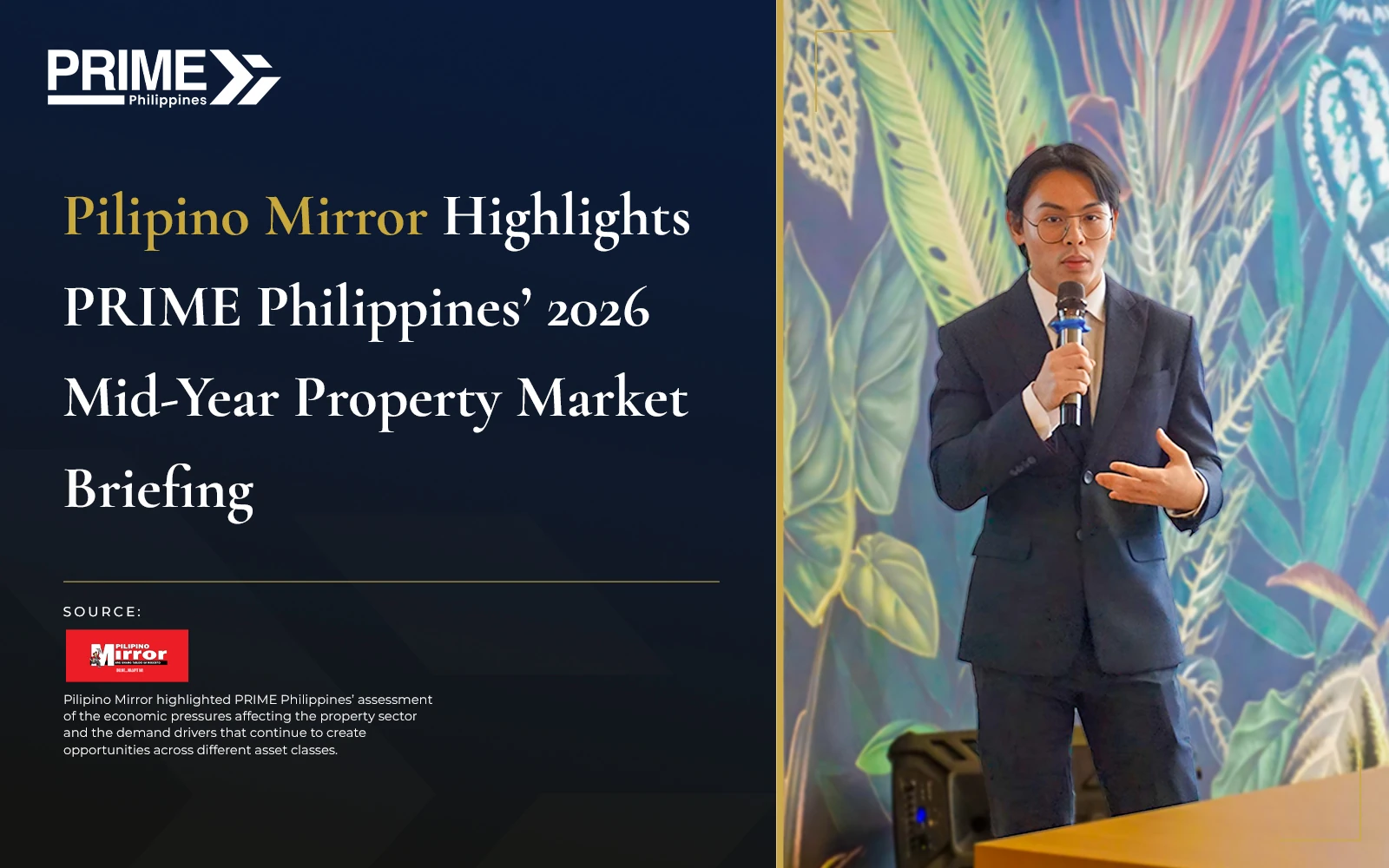
In its coverage of the PRIME Philippines 2026 Mid-Year Property Market Briefing, Pilipino Mirror highlighted PRIME Philippines’ assessment of the economic pressures affecting the property sector and the demand drivers that continue to create opportunities across different asset classes.
The coverage examined how interest rates, inflation, slower economic growth, geopolitical conflict, and weaker business confidence are influencing financing, investment, and real estate decisions. At the same time, it emphasized that the market is not defined by risk alone.
Economic Pressure Is Changing Property Market Decisions
Pilipino Mirror highlighted PRIME Philippines’ assessment of a more challenging financing environment. Higher borrowing costs can affect homebuyers, businesses, and developers by increasing the cost of acquiring property, funding construction, and supporting expansion.
Consumer confidence is another important factor. When households and businesses become more cautious about their finances, discretionary spending and long-term investment decisions may slow. This can affect retail activity, development timelines, and demand across the property market.
Foreign investment also remains an area to monitor. According to the PRIME Philippines findings cited by Pilipino Mirror, foreign direct investment declined by 26% from January to April 2026. This places greater pressure on the Philippines to strengthen its competitiveness as other Southeast Asian economies pursue the same investors and occupiers.
These conditions do not affect every property sector or location equally. Their impact depends on the source of demand, financing structure, business model, and exposure of individual developments to changes in consumer and investor confidence.
Business Sentiment Is More Resilient Than Expected
Despite prevailing economic concerns, PRIME Philippines’ early business-confidence survey presented a more measured outlook.
Pilipino Mirror reported that almost half of the landlords, investors, and property occupiers surveyed said their income had not been heavily affected by the Middle East conflict. Among businesses that experienced losses, most reported declines of between 1% and 10%.
Many respondents also described their outlook as neutral to optimistic.
The findings suggest that while businesses remain alert to current risks, they are not uniformly retreating from the market. Decision-makers may be more selective, but selectivity is different from inactivity.
For the property sector, this distinction matters. Businesses may delay certain commitments or negotiate more carefully, while continuing to pursue locations and assets that directly support their operations.
Consumer Growth Can Support Retail Demand
Pilipino Mirror also highlighted PRIME Philippines’ view of the country’s expanding middle-income population as a potential source of long-term demand.
As more households gain disposable income, spending on food, shopping, entertainment, services, and other consumer activities can support retail expansion. The opportunity, however, depends on whether retail developments respond to the actual needs and spending capacity of their trade areas.
Developers and landlords must look beyond broad demographic growth. Location, accessibility, tenant mix, competition, and consumer behavior remain essential in determining which concepts can perform within a particular market.
A Weaker Peso Presents Sector-Specific Opportunities
Currency depreciation can increase the cost of imported goods and construction inputs, but its effects are not entirely negative.
As highlighted by Pilipino Mirror, PRIME Philippines identified the IT-BPM sector as one potential beneficiary. Because the industry earns substantial revenue from international clients, a weaker peso may strengthen the local value of foreign-currency earnings and help preserve the Philippines’ cost competitiveness.
For the office market, this can support continuing demand from outsourcing and service-oriented occupiers. However, the location and form of that demand may continue to change as companies compare labor costs, available talent, infrastructure, and occupancy expenses across Metro Manila and provincial markets.
E-Commerce Continues to Support Warehouse Demand
E-commerce remains another structural opportunity for Philippine real estate.
As online transactions increase, retailers, logistics companies, and distributors require facilities that can support inventory storage, order processing, and last-mile delivery. Pilipino Mirror highlighted PRIME Philippines’ assessment that this growth can contribute to continued demand for warehouses and other industrial properties.
The opportunity is not limited to adding more space. Modern logistics operations require facilities with the right location, accessibility, loading capacity, power infrastructure, and proximity to consumers and transport networks.
For occupiers and investors, warehouse decisions must therefore be based on operational fit as much as market demand.
Long-Term Risks Require Real Estate Planning
The briefing also addressed risks extending beyond near-term economic conditions. Pilipino Mirror cited PRIME Philippines’ discussion of a potential major earthquake in Metro Manila, El Niño, and water-supply constraints.
These risks have direct implications for property planning. They can affect construction costs, business continuity, utility reliability, insurance considerations, and the long-term resilience of individual assets.
For developers, occupiers, and investors, resilience must be considered alongside location, rental rates, and projected returns. Properties must be assessed not only for how they perform under current market conditions, but also for how effectively they can support operations during disruption.
Property Market Outlook: Assessing Challenge and Opportunity
Pilipino Mirror’s coverage of PRIME Philippines’ 2026 Mid-Year Property Market Briefing reinforces a central market reality: risk and opportunity can exist at the same time.
Interest rates, inflation, weaker confidence, and lower foreign investment are creating a more demanding operating environment. Yet the growing middle class, IT-BPM activity, e-commerce, and the continuing need for homes, offices, retail spaces, and warehouses continue to support real estate demand.
The appropriate response is neither excessive caution nor unfounded optimism. It is disciplined, evidence-based decision-making.
PRIME Philippines provides market research and strategic advisory services to help occupiers, developers, landlords, and investors evaluate changing conditions across the Philippine property market.
Navigate market uncertainty with clearer real estate intelligence. Talk to our advisor now.