Mall strategy in the Philippines is moving beyond foot traffic. As younger consumers place greater value on dining, recreation, wellness, entertainment, and social experiences, the question is no longer only how many people enter a mall, but what gives them a reason to stay and return.
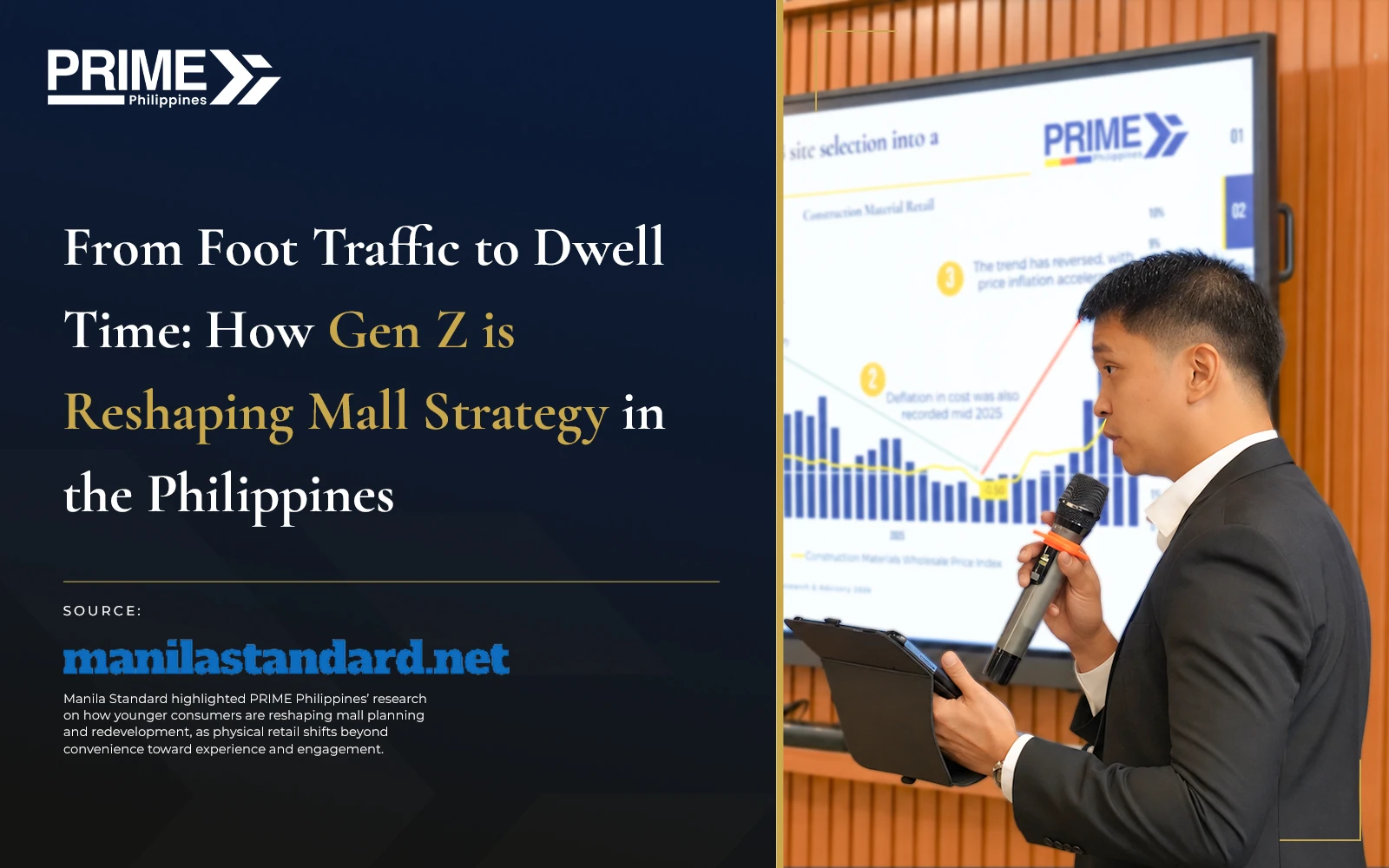
This shift is becoming more visible across Philippine retail. Manila Standard highlighted PRIME Philippines’ research on how younger consumers are influencing the planning, positioning, and redevelopment of malls. With more transactions now taking place online, physical retail must offer something beyond convenience alone.
The country’s demographic profile makes this especially relevant. According to the Philippine Statistics Authority, the median age of the Philippine population stood at 27.7 years in the 2024 Census of Population. Filipinos aged 15 to 30 also accounted for 28.8% of the household population. As this younger market shapes how people shop, dine, socialize, and spend their free time, its influence is increasingly being felt in mall strategy, tenant mix, and asset positioning.
Experience Is Becoming a Retail Growth Driver
E-commerce has raised expectations for physical retail. Product availability, price comparison, and purchasing convenience can increasingly be addressed online. What malls can offer differently is the ability to bring shopping together with dining, recreation, entertainment, and social interaction within the same destination.
This shift is already evident among major operators. Manila Bulletin highlighted the growing importance of experience and human interaction in physical retail. GMA News also reported that SM Supermalls has expanded its experiential offerings to include 102 pickleball courts and 22 running hubs. The operator also formed a Gen Z Council to gain a clearer understanding of emerging interests among younger consumers.
For mall strategy, this involves more than adding amenities. Experience-led concepts can give consumers more reasons to remain in the property, explore its different areas, and return more frequently. Experiential retail is therefore becoming increasingly relevant to leasing decisions, asset positioning, and long-term competitiveness.
Tenant Mix Is Following Consumer Behavior
As the purpose of a mall visit changes, the tenant mix must respond.
PRIME Philippines’ retail research indicates that 59% of Filipino respondents dine out at least once a week. Dining remains an important part of the mall experience, while wellness, beauty, recreation, grocery, convenience, and other lifestyle uses are playing a larger role in how consumers use retail destinations.
There is no single tenant formula that works for every property. The right mix depends on the trade area, target market, competitive environment, property positioning, and existing tenant base. A neighborhood mall may depend more heavily on convenience and everyday services, while a larger destination may require a stronger combination of dining, entertainment, recreation, and experiential concepts.
This changes the leasing question from simply who can occupy a space to what each tenant contributes to the wider property. Some uses generate regular visits. Others extend dwell time or strengthen the mall’s identity as a destination. Tenant mix therefore becomes a more deliberate component of mall strategy, rather than an exercise in filling available space.
Mall Strategy in the Philippines Is Moving Beyond the Storefront
The growing emphasis on experience is also influencing investment in the physical asset.
Manila Standard cited PRIME Philippines’ research identifying more than ₱170 billion in combined redevelopment commitments from major Philippine mall developers through 2030. The scale of these investments reflects a broader effort to reposition conventional shopping centers as more relevant lifestyle destinations.
Redevelopment involves more than updating a mall’s appearance. Changes in consumer behavior affect space configuration, circulation, tenant adjacency, gathering areas, infrastructure requirements, and the distribution of uses throughout the property.
This is where design and leasing increasingly converge. A strong tenant may attract people to the mall, but the surrounding mix, layout, and experience determine where visitors go next and how long they remain.
The value of dwell time comes from giving consumers meaningful reasons to engage with more of the asset.
Strong Occupancy Is Not Stopping Redevelopment
One of the clearest market signals is that redevelopment continues even while mall occupancy remains relatively strong.
Manila Standard highlighted PRIME Philippines’ findings showing overall mall occupancy at approximately 93% in the first quarter of 2026, up from 88.2% in 2022. GMA News likewise reported that SM Supermalls reached a 96% long-term occupancy rate while continuing to expand its portfolio and introduce new experiential concepts.
These figures should not be interpreted as proof that experiential strategies alone are driving occupancy. They show that redevelopment is not simply a response to vacant space. Major operators are investing while their properties remain well occupied.
For asset owners, that distinction matters. A highly occupied mall is not automatically a future-ready mall. Long-term competitiveness also depends on whether the property’s tenant mix, physical environment, and overall proposition remain relevant as consumer expectations evolve.
Strategic Outlook: From Traffic to Time Spent
Foot traffic will remain fundamental to retail real estate, but the value of that traffic increasingly depends on what happens after consumers enter the property.
For younger and digitally connected consumers, routine purchases can often be completed online. Physical retail must therefore compete through experiences that are more difficult to reproduce on a screen, including dining, recreation, discovery, interaction, convenience, and community.
For mall strategy in the Philippines, the objective is not to replace conventional retail with entertainment or pursue dwell time for its own sake. The stronger approach is to align consumer behavior, tenant mix, physical space, and investment strategy so that each supports the performance of the wider asset.
The benchmark for relevance is changing. Getting consumers through the door still matters. Giving them enough reasons to stay, engage, and return is becoming equally important.
PRIME Philippines provides retail market research and strategic real estate advisory services to help developers, landlords, and investors respond to changing consumer demand.
Build a mall strategy grounded in market intelligence. Talk to our advisor now.