
Philippine property market resilience depends on more than headlines. Market fundamentals determine whether businesses continue to lease, expand, and invest.
In its feature, “The Confidence Gap: Philippine Real Estate Holds Its Ground Amid Economic Turbulence,” PAGEONE highlighted PRIME Philippines’ analysis of Philippine property market resilience during the first half of 2026. The coverage drew from PRIME Philippines’ Mid-Year Property Market Report, The Confidence Gap: Closing the Distance Between Fear and Fact.
PAGEONE’s discussion centered on a critical distinction identified in the report: weaker confidence does not automatically mean weaker property fundamentals. Although economic growth slowed and businesses faced higher costs, activity across the retail, office, and industrial sectors continued, with each segment responding differently to market pressure.
The Confidence Gap Is Shaping Property Decisions
Economic uncertainty can delay investment, restrict expansion, and make businesses more cautious about long-term commitments. However, PRIME Philippines’ findings show why decisions should not be based on sentiment alone.
As highlighted by PAGEONE, PRIME Philippines’ stakeholder survey found that most respondents remained optimistic about the months ahead despite the disruptions experienced during the first half of the year.
This does not mean that market risks have disappeared. It means that businesses and investors are distinguishing short-term uncertainty from the longer-term demand drivers influencing commercial real estate.
Retail Demand Continues to Evolve
PAGEONE cited PRIME Philippines’ findings on how younger consumers are reshaping the retail sector. With Gen Z and Millennials representing a substantial share of the Philippine population, retailers are adapting their formats to changing preferences, spending habits, and expectations.
Mall occupancy remained above 90% among most major developers. Value retailers, convenience stores, quick-service restaurants, and food and beverage concepts also continued to expand.
The strength of these categories suggests that retail demand has not disappeared. It has become more selective, rewarding concepts that respond directly to how consumers now shop, dine, and spend their time.
Office Demand Is Becoming More Cost-Conscious
The office market showed greater sensitivity to economic and operational pressures. PAGEONE highlighted PRIME Philippines’ finding that nationwide office requirements declined by 15% year on year, with some IT-BPM demand shifting from Metro Manila toward provincial and offshore markets.
This movement reflects a broader recalibration of workplace decisions. Occupiers are assessing labor costs, capital expenditure, lease flexibility, and location more closely before committing to space.
Flexible workspaces are also becoming more relevant for companies looking to manage upfront costs and maintain greater control over the size and duration of their office commitments.
Industrial Fundamentals Remain Strong
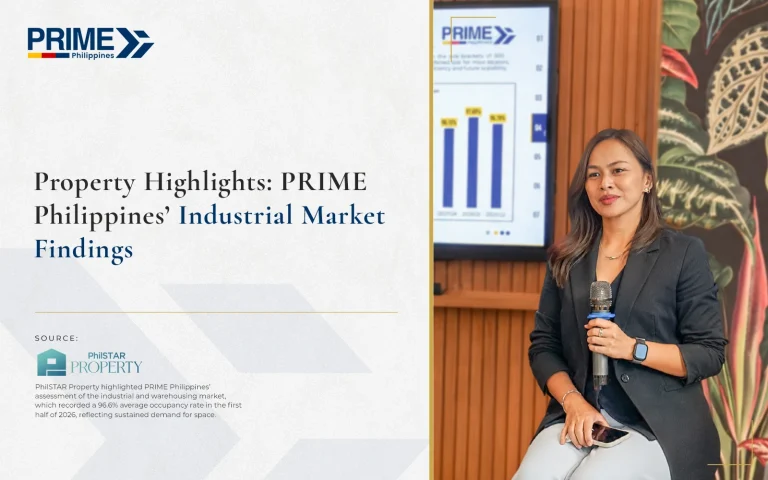
Industrial real estate remained the strongest-performing property segment covered in the report. According to the PRIME Philippines findings highlighted by PAGEONE, industrial occupancy stayed above 96% despite higher energy and financing costs.
Manufacturing continued to support demand, while third-party logistics providers benefited from the expansion of e-commerce and increasingly complex supply-chain requirements.
Strong occupancy in Cebu and Davao also demonstrated that industrial growth is extending beyond Metro Manila. At the same time, differences among Pampanga, Bulacan, Batangas, and other industrial markets reinforce the importance of evaluating each location based on its supply pipeline, tenant base, infrastructure, and rental conditions.
Real Estate Strategy Requires Evidence, Not Assumptions
PAGEONE’s coverage reinforces the central argument of PRIME Philippines’ report: economic anxiety and actual property performance do not always move together.
Retail is responding to demographic and consumer change. Office occupiers are prioritizing flexibility and cost efficiency. Industrial real estate continues to benefit from logistics, manufacturing, and regional expansion.
The market is neither uniformly strong nor broadly retreating. It is becoming more selective.
For decision-makers, this environment demands a clearer understanding of sector performance, location-specific conditions, and the forces supporting demand. Market confidence may shift quickly, but sound real estate decisions must remain grounded in evidence.
PRIME Philippines provides research, market intelligence, and strategic advisory services for occupiers, developers, and investors navigating the Philippine commercial real estate market.
Turn market intelligence into better real estate decisions. Talk to our advisor now.