
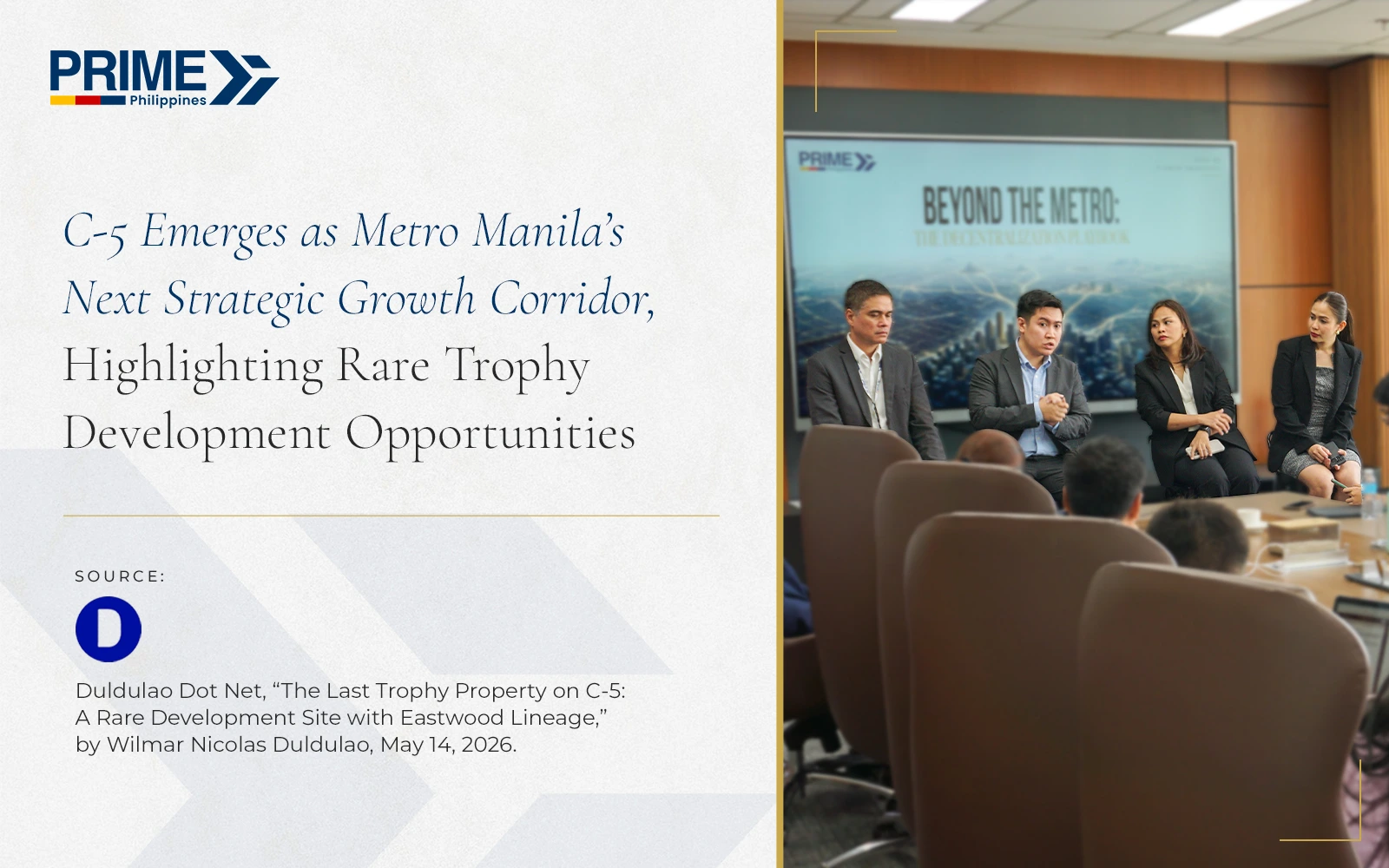
C-5 is increasingly being recognized as one of Metro Manila’s most important growth corridors, attracting the attention of developers, investors, and institutional capital seeking long-term opportunities in a rapidly evolving urban landscape.
According to a report published by Duldulao.net, the corridor is entering a new phase of development driven by infrastructure expansion, improved connectivity, and the growing scarcity of large-scale development sites within Metro Manila.
As traditional business districts become more mature and land availability continues to decline, growth corridors such as C-5 are emerging as strategic locations capable of supporting the next generation of commercial, mixed-use, and institutional developments.
Infrastructure and Connectivity Fuel Growth
The continued transformation of C-5 is largely supported by its role as a critical transportation artery connecting multiple business districts, residential communities, and emerging economic centers across Metro Manila.
Infrastructure improvements and increasing accessibility have enhanced the corridor’s attractiveness to businesses and developers seeking locations that offer both visibility and long-term growth potential.
As urban development expands beyond traditional central business districts, connectivity has become one of the most important drivers of property value and investment activity.
Scarcity Creates Opportunity
One of the defining characteristics of Metro Manila’s property market is the limited availability of large, strategically located development sites.
As developable land becomes increasingly scarce, investors are placing greater emphasis on properties that offer scale, flexibility, and the ability to support multi-phase projects.
According to the report, a rare development property along C-5 exemplifies this trend, offering significant frontage and development potential within one of the capital region’s most active growth corridors.
Market observers note that opportunities of this scale have become increasingly uncommon, particularly in locations with established accessibility and strong commercial visibility.
Institutional Capital Shifts Toward Strategic Corridors
The growing interest in C-5 reflects a broader trend within the real estate sector, where institutional investors are targeting assets aligned with long-term demographic, infrastructure, and economic growth patterns.
Developers, REIT-backed groups, infrastructure operators, and large-scale investors are increasingly evaluating corridors that can accommodate future demand across multiple sectors, including commercial, logistics, technology, and mixed-use developments.
These investment decisions are often influenced not only by present-day market conditions but also by a location’s capacity to generate value over the coming decades.
Lessons from Metro Manila’s Landmark Developments
The report draws attention to historical examples where strategic land acquisitions ultimately became transformative developments.
Among the most notable examples is Eastwood City, which began as a land assembly initiative before evolving into one of the country’s pioneering integrated townships and a major catalyst for the Philippine business process outsourcing industry.
While every development opportunity follows a different trajectory, such examples highlight how infrastructure, vision, and timing can shape long-term real estate value.
Outlook for C-5
As Metro Manila continues to expand, C-5 is expected to play an increasingly important role in the region’s commercial and urban development landscape.
Improving infrastructure, sustained investment activity, and limited land availability are likely to reinforce the corridor’s strategic importance in the years ahead.
For investors and developers, the emergence of rare trophy development opportunities along C-5 highlights the growing significance of securing well-positioned assets within one of Metro Manila’s most dynamic growth corridors.
Source
This article is based on information reported by Duldulao.net and insights shared by real estate writer Wilmar Nicolas Duldulao regarding the evolving role of C-5 as a strategic growth corridor and the emergence of rare large-scale development opportunities along the route.