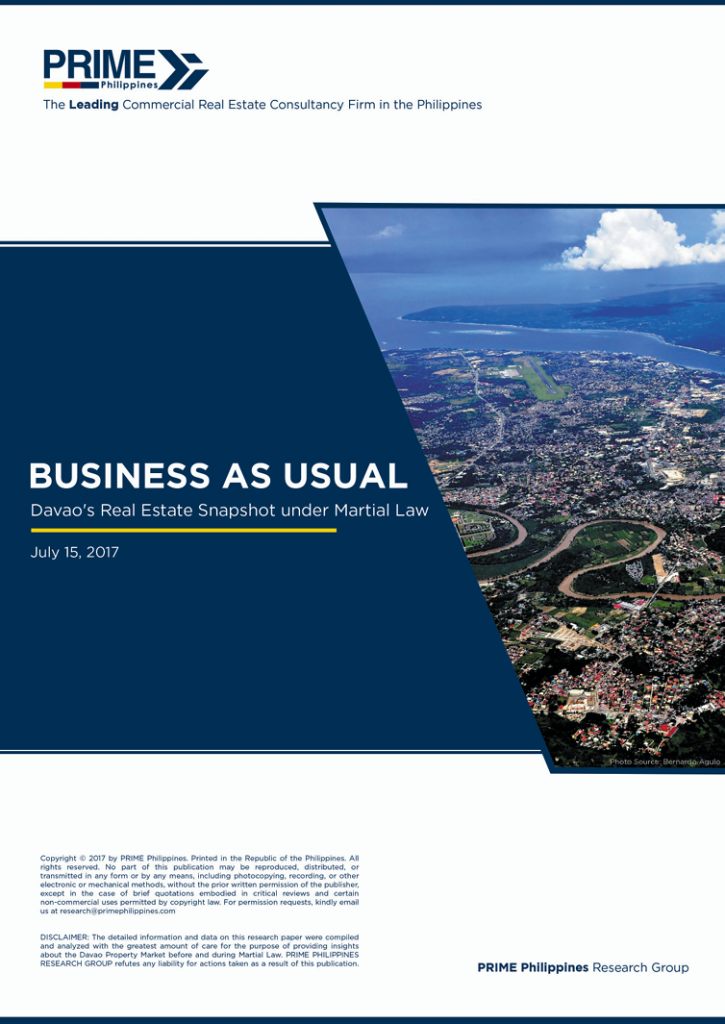
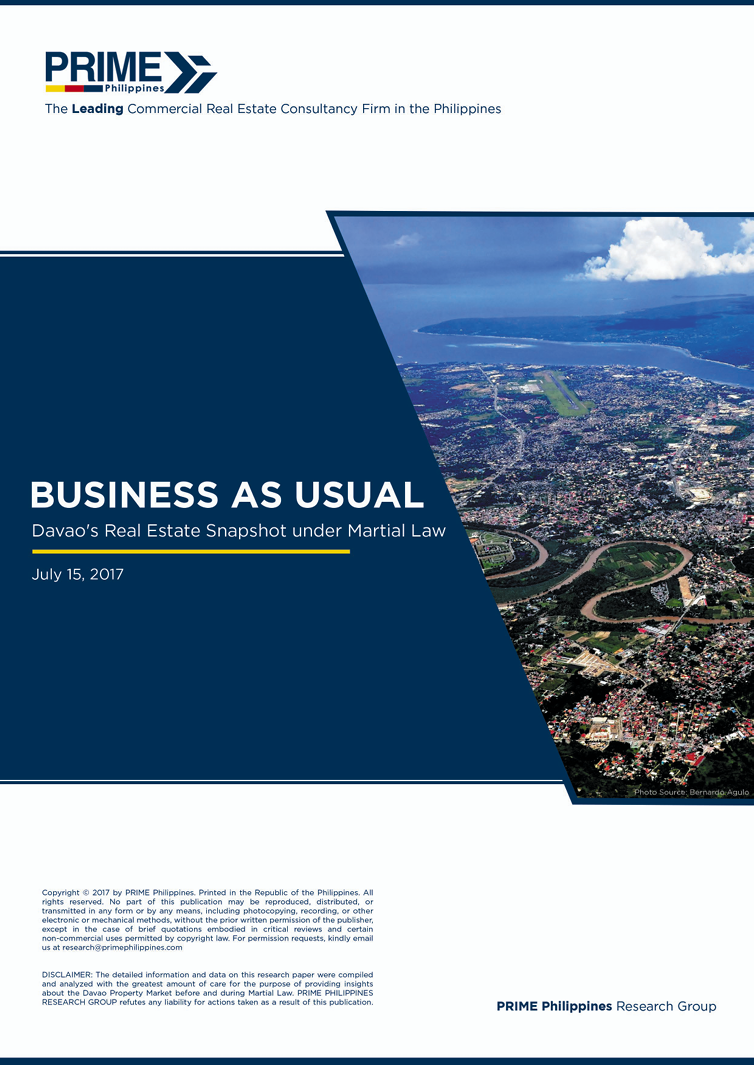
When Martial Law was declared in Mindanao on May 23, 2017, concerns quickly emerged around security, tourism, and investment sentiment in Davao City. However, the policy environment differed fundamentally from the 1972 declaration, as it remained geographically limited to Mindanao while civil courts, Congress, and local government units continued to function. From a real estate and investment perspective, market behavior reflected stability among existing stakeholders rather than broad-based withdrawal.
Investor sentiment data supports this resilience. A PRIME Philippines survey showed that 83.3% of Davao-based investors with existing holdings remained willing to reinvest, while 66.7% of Luzon and Visayas investors already exposed to Davao maintained their positions. Only first-time investors largely delayed entry, indicating that market familiarity was a key driver of confidence. This was reinforced by business registration data, with Q2 2017 new permits rising 17.2% quarter-on-quarter and total capitalization increasing by 40%, signaling continued commercial expansion despite political uncertainty.
Hotel Sector: Tourism Softening on External Perception
The hotel sector experienced the most immediate impact. Occupancy and gross revenues declined in June 2017 compared to earlier months, primarily driven by external perception risks following the Marawi conflict. Event cancellations resulted in approximately PHP 20.9 million in unrealized revenues as of June 6, 2017. Notably, the downturn was influenced more by apprehension from Luzon, Visayas, and foreign markets than by actual on-ground conditions in Davao.
Residential Sector: Stable End-User Demand
The residential condominium market remained broadly stable, with gross sales holding steady from January to June 2017. Demand was largely end-user driven within Mindanao, where sensitivity to Martial Law was comparatively low. OFW and balikbayan buyers continued to support absorption, and no significant price corrections were observed.
Office Sector: Continuity and Expansion
The office market operated under business-as-usual conditions. Damosa IT Park maintained full occupancy at 100%, while leasing activity from both local and multinational firms continued. A Canadian firm signed a letter of intent for a building under construction, and leasing momentum normalized shortly after a brief pause in the first week of Martial Law.
Land Investment Sector: Continued Capital Appreciation
Prime land values in key Davao districts increased between Q4 2016 and Q2 2017, with no post-declaration decline. Growth was supported by infrastructure development, improved security conditions, and sustained investor confidence. A reported 44% reduction in crime rates further strengthened the city’s investment profile.
Outlook
Davao City’s real estate market demonstrated structural resilience across office, residential, and land sectors under Martial Law. While tourism experienced a temporary decline due to external perception, core property segments remained stable or grew. Rising business registrations, increasing capitalization, and sustained leasing activity underscore a key conclusion: Martial Law functioned primarily as a security stabilizer rather than a market disruptor. For informed investors, Davao continued to operate under a “business as usual” framework, reinforcing its position as a fundamentally stable and investable real estate market even under heightened security conditions.
Contact us to get a copy of the full publication!