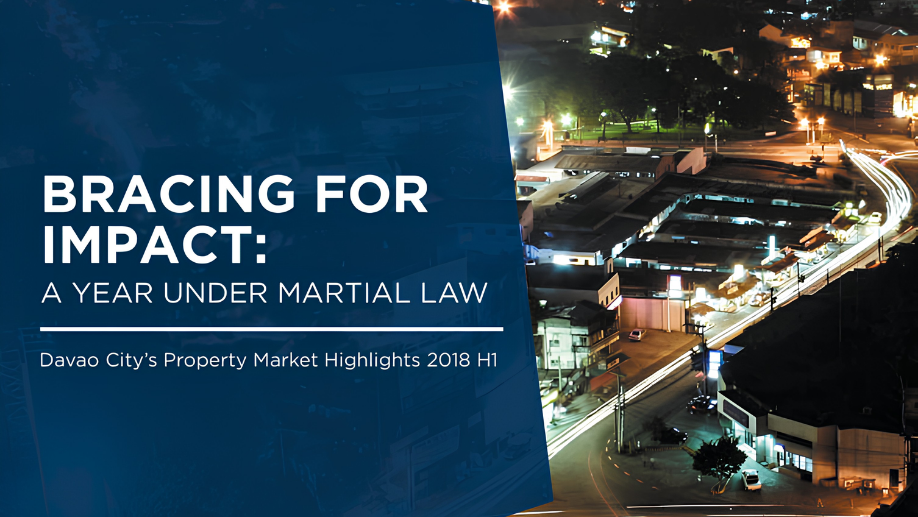
One year after the declaration of Martial Law in Mindanao in May 2017, Davao City’s property market demonstrated notable resilience despite a cautious investment climate. While sentiment temporarily softened in select segments, the city’s core economic drivers remained intact. Tourism recorded a 13% annual increase in arrivals, supported by sustained marketing efforts and roadshows reinforcing Davao’s positioning as a safe and stable destination. Agribusiness continued to anchor export performance in coconut, banana, corn, rice, cassava, and bamboo, while infrastructure-led employment under the government’s “Build, Build, Build” program supported construction activity and broader economic stability. Overall, Davao maintained its role as Mindanao’s primary economic hub, with strong fundamentals offsetting perceived political risk.
Retail Sector: Selective Expansion Amid Cautious Entry
Retail growth moderated in H1 2018 as external brand expansion slowed. International and non-local entrants reduced their pace of market penetration, while domestic brands continued expansion, particularly in fuel retail and food and beverage segments. These operators increasingly favored standalone formats over in-line mall space. Despite steady local activity, major anchor brand rollouts remained limited due to tempered investor confidence under extended Martial Law conditions.
Office Sector: Supply Growth Outpacing Demand
The office market experienced a temporary imbalance, with supply increasing by 20% while leased space grew by only 10%, resulting in downward pressure on occupancy. Grade A offices were most affected, recording approximately 70% occupancy, while Grade B and C assets remained more stable at around 90%.
Demand from IT-BPO firms slowed significantly, with no new major anchor entrants during the period. Prior to Martial Law, select BPO firms had multiple expansions, while post-declaration expansion activity stalled. However, local demand provided partial support, with government tenants occupying over 2,000 sqm and insurance firms continuing gradual expansion.
Residential Sector: Stable Demand from End-Users
The residential condominium market remained resilient with an average take-up rate of 83%. Demand was primarily driven by domestic buyers from Mindanao, alongside steady contributions from OFWs and balikbayans, who showed limited sensitivity to Martial Law conditions.
Pricing remained stable, with studios averaging PHP 2.8 million, one-bedroom units at PHP 4.15 million, and two-bedroom units at PHP 7.45 million. Key residential corridors such as J.P. Laurel Avenue, Matina, and Poblacion maintained strong occupancy. Developers including SMDC, Ayala Land Premier, Cebu Landmasters, and Dusit expanded their pipeline targeting Class A and B segments.
Land Sector: Continued Capital Appreciation
Commercial land values increased by 20% year-on-year from H1 2017 to H1 2018. Bajada-Lanang led the market at approximately PHP 81,000 per sqm, while Matina and Poblacion recorded the strongest growth at 25% and 28%, respectively. Infrastructure development, commercial expansion, and sustained investor confidence drove this appreciation, with Martial Law having minimal long-term impact on land values.
Hotel Sector: Strengthening MICE-Driven Demand
Tourism growth of 13% CAGR supported hotel sector expansion. Davao’s positioning as a MICE destination strengthened, with approximately 1,500 new rooms expected by 2020. Economy and midscale rooms accounted for 74% of supply, while first-class and deluxe segments achieved 75% to 85% occupancy, indicating strong unmet demand for higher-tier hospitality offerings.
Outlook
Davao City remains cautiously optimistic. Residential, land, and hotel sectors are expected to sustain growth, supported by infrastructure development, OFW capital inflows, and tourism expansion. Retail and office markets may remain subdued in the near term, pending improved investor confidence and stabilization of political perceptions.
Nevertheless, the city’s diversified economy, strong agribusiness base, and growing infrastructure pipeline position it for a rapid rebound. As Mindanao’s gateway city, Davao continues to represent a long-term strategic investment market with strong upside potential for prepared investors.